Urinating vixens, greedy pigeons, May frost and idiosyncratic mowers are just a few of the problems facing Wimbledon's head groundsman in the run up to the world's most famous tennis championships.
Most tournaments, even if they once were played on grass, now use easier-to-manage hard or clay courts, but for Eddie Seaward the yearly cycle of growth and tending is part of the joy of his job, wildlife notwithstanding.
Foxes who roam freely round leafy and prosperous Wimbledon, in southwest London, are regular visitors to the All England Club, even seen creeping across the commentary boxes high on Centre Court. They are welcome as long as they keep off the grass.
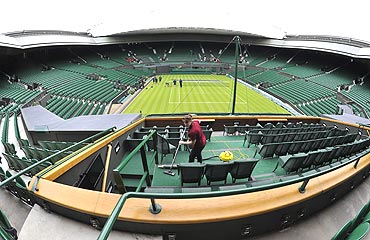
"We put an electric fence round here and the showcourts most of the year," Seaward told Reuters as his staff and an army of cleaners and contractors busied themselves round the pristine green sward of Centre Court preparing for Roger Federer on Monday's opening day.
"It's the vixens that are the problem, if they urinate on the court it just kills the grass off," he added.
Centuries-old methods, in keeping with Wimbledon's love of tradition, are used to keep at bay the pigeons, who would otherwise gorge on newly sown seed.
"We have a hawk to scare off the pigeons. It flies three times a week and that deters them," he said. The falconer and his hawk are kept busy even during the championship fortnight so that the pigeons do not come back and bother players and crowd.
Seaward, chief groundsman since 1991 has delayed retirement to stay on until the 2012 Olympics, when Wimbledon will host the tennis tournament.
He has overseen changes from a grass mixture to a 100 percent rye grass which is tougher and helps to create a harder surface. Critics say the courts have slowed down, penalising the serve-and-volley aficionados, but Seaward, who constantly measures the courts' performance, says speed is unchanged.
What has altered is the height of the bounce.
"It's slightly less dense which allows more air movement through the grass and that helps the soil get harder quicker which means the ball bounces higher from day one," he said.
Players had a fraction of a second longer to reach a higher-bouncing ball, instead of having to catch it low off the ground, he explained.
"The bounce was lower because the ground was softer. That's the only difference."
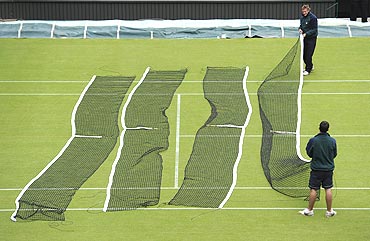
The stoical Seaward and his 14 permanent staff have had a particularly difficult growing year. A sharp late frost in May when nothing would germinate meant they had to cover the courts with a membrane to create a greenhouse effect and warm the soil.
"Then it was hot and dry, then it got cold again so all the way along we've had to battle the weather this year - but that's what we do, that's our job," Seaward, who has weather forecasts sent to him every hour, said.
As he stared across his unblemished court, the groundsman was sympathetic to the problems that Wembley Stadium in north London has been suffering with its much-criticised pitch, constantly churned up and needing renewal.
Wembley had to try to keep its turf in top condition the whole year, he said. It needed the ball to roll rather than bounce so it had a sandy rather than clay soil.
"I don't think you can compare them, it's like chalk and cheese," Seaward said. "We grow the grass at the right time of the year - in the summer - and we've got to have it in peak condition for only two weeks really."
To ensure top conditions and make sure the lawns look good too, Seaward allots each of his staff a court to mow with the same mower throughout the buildup and the tournament itself.
All machines were different, he explained, and all operators had their own way of mowing. If a different machine or cutter were used, the lines would not be perfect, the light and shade would not match and the court would look wrong.
"We want to get everything just right."

 © 2025 Rediff.com - Investor Information - Advertise with us - Disclaimer - Privacy Policy - Feedback - About us - Terms of use - Grievances