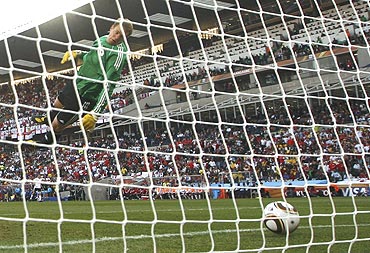
Introducing goalline technology at soccer stadiums would prove a cheaper, as reliable aid to referees than UEFA's method of two additional assistants, according to manufacturers.
UEFA will expand the use of five referees to some Champions League matches and European Championship qualifiers this season after a successful trial in the Europa League, but German company Cairos Technologies feel their solution should be used.
"You need to pay a referee each time for each match and two more referees, that is more expensive than having goalline technology," Cairos sales director Mario Hanus said on the sidelines of the Soccerex Asian forum in Singapore this week.
UEFA were not immediately available for comment.
Following Frank Lampard's disallowed effort for England in their World Cup second round defeat by Germany in South Africa last month there has been much talk at the forum, and in the sport, about using technology.
FIFA President Sepp Blatter apologised to England after the match and the Swiss said the topic of goalline technology would be discussed by soccer law-makers the International Football Association Board (IFAB).
However, last week IFAB, which consists of one representative from each of the four British associations and four from FIFA, left the topic off their agenda which Hanus said was frustrating.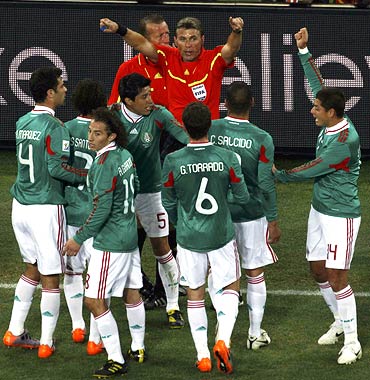
"It was a little surprising for us (the rejection) as we have had so many voices around asking for the technology, players referees some of the club managers etc.
"The Bundesliga, I believe, would be ready to introduce it. Referees all around the globe say 'please we are the ones who are blamed if we take the wrong decision'," Hanus said.
The next opportunity for IFAB to discuss the matter of goalline technology will be at their business meeting in October, with law-changing unable to happen until after their annual meeting in March. "(a few years ago) They (IFAB) asked us to change a few things and we did that and it worked and then the decision was against although we had done those changes.
"We were not expecting it to be introduced worldwide in all stadia but at least in a first league or something.
"There is actually nothing we think that needs to be done but if there was, we are here, we are open to talk."
Hanus also rejected concerns about the chip-in-ball technology failing at key moments perhaps due to a power outage, saying it was as reliable as any referee.
"If there is no power in the stadium there will be no floodlights and there will be no match so I would say that is not scaring us.
"The two additional referees can be stuck with an airplane that cannot fly because of volcano ash, there is no 100 percent guarantee in life," Hanus said, referring to the Icelandic ash cloud that downed much of Europe's airspace in April.
 © 2025 Rediff.com - Investor Information - Advertise with us - Disclaimer - Privacy Policy - Feedback - About us - Terms of use - Grievances