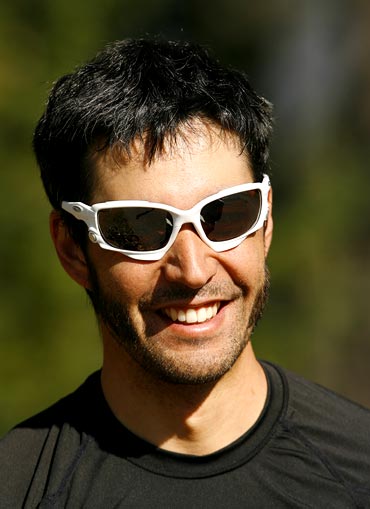
Legally blind since his late teenage years, Canada's Brian McKeever will achieve a long-cherished dream and a place in the record books when he represents his country at this month's Vancouver Olympics.
The popular cross-country skier from Canmore, Alberta, will become the first athlete to compete in both a Winter Olympics and a Paralympics and he fervently hopes to inspire as many people as he can, whether they are disabled or able-bodied.
McKeever has already inspired his Canadian team mates, many of whom view him as an able-bodied skier blessed with extraordinary talent.
"Brian is a standout athlete and he's a standout person," 2006 Olympic silver medallist Sara Renner said. "He's a really hard worker and he never ever talks about his disability.
"As a team mate, I don't even notice it because he accepts nothing but his very best. Nothing holds him back. He is a real inspiration to all of us in overcoming weaknesses and being optimistic and positive. He's just an incredible athlete."
Cross country all-rounder Devon Kershaw knows McKeever very well after training with the 30-year-old countless times.
"You almost forget for a second that he can only see 10 percent of what I can see," Kershaw said.
"You see him in the evening trying to read something and his face is right up against it. You know the struggle that he has gone through to get to where he is. He is such an inspiration to us all."

McKeever, who suffers from Stargardt's disease, booked his place on the Canadian team for Vancouver by winning an able-bodied 50km race in Canmore in January.
That victory ranks as one of his proudest moments.
"That was a big one for me," McKeever said. "It marked a lot of different firsts -- maybe the most notable one being that it was actually my first win at that level as a senior in Canada.
"I've had some good races in the juniors but it took me 10 years to get my first win in the senior ranks, so I am pretty proud of that.
"It was four years of preparation for that one particular event -- gearing my training towards going long distances and having a really big focus on it. And then to have it all come together on the day which is often the most difficult thing."
McKeever, who has only 10 percent vision which is limited to peripheral, will return to British Columbia for the Paralympics in March. He has already won seven medals at previous Paralympic Games, alongside his older brother Robin who acts as his guide.
At the Olympics, however, he will have to race alone.
"I will miss Robin for sure but I also have a great team that I am a part of and they will be able to fill that role as well," McKeever said.
"Most of my races are mass start events and I will be able to follow other people in those events. So there will be lots of guides, you just have to be aware that they are not racing with you, they are trying to beat you."
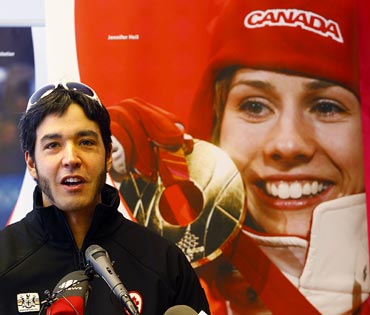
McKeever's favourite event is the 50km classical but he would also like to compete in the 30km pursuit at Whistler Olympic Park.
He feels no extra pressure, though, to perform well at the Games simply because he is poised to complete a unique Winter Olympics-Paralympics double.
"Other people will make that an issue," he said. "It will be media-driven and public-driven on whether or not this is supposed to be significant.
"What's significant for me is that I have achieved a goal that I set out a long time ago and that all the steps leading up to it were followed. I hope that inspires other people with disabilities to get involved and active in sports.
"Maybe it can even inspire the able-bodied public, make them think: if a blind guy can do it, then there's no excuses to getting out there and getting on a pair of skis."
Asked to describe what he could and could not see, McKeever replied: "My vision is very similar to something like flash bulb eye, where you've been exposed to a very bright light and you've got that lingering flash bulb blindness right after.
"Luckily for me, for spacial relations like getting around a ski course, all of that's mainly peripheral vision. Central vision is more limited to fine detail recognition, colours, recognising people's faces and things like that.
"If you asked me to try and read something, I am pretty useless and I don't certainly know who is standing next to me as I'm skiing past," said McKeever, who was declared legally blind before he was 20.
"As a cross-country skier, I always say that if I can stay on the white bit between the green, I will be pretty safe, and I can do that all right."

 © 2025 Rediff.com - Investor Information - Advertise with us - Disclaimer - Privacy Policy - Feedback - About us - Terms of use - Grievances